


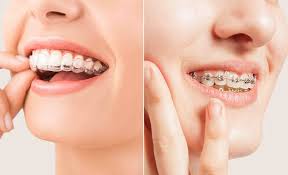
You look at your teeth in the mirror and notice crowding, gaps, or teeth that overlap. Maybe you have avoided smiling in photographs for years, or you are simply tired of feeling that your teeth do not sit properly.
Braces and clear aligners are two common ways to move teeth gradually into better positions. The right option depends on your teeth, bite, treatment goals, and how consistently you can follow the treatment plan.
Many people think orthodontic treatment is purely about having a straighter smile.
Straightening teeth can also make certain areas easier to clean and may help address some bite problems. However, not every crooked tooth requires orthodontic treatment.
Crowding is only one part of the picture. An orthodontic assessment can also look at gaps, overbite, underbite, crossbite, tooth rotation, and the relationship between the upper and lower teeth.
That is why choosing braces or aligners should come after an examination rather than simply selecting whichever option looks more attractive.
Traditional braces use brackets and wires to apply controlled forces to the teeth over time.
Your dentist or orthodontic professional periodically adjusts the treatment according to how your teeth are moving.
Braces can be used for many types of alignment and bite concerns, including cases that may be more complex.
Clear aligners are removable trays designed to gradually move teeth according to a planned sequence.
They can be appealing to patients who prefer a less noticeable orthodontic option. However, they need to be worn as instructed, and taking them out frequently can affect treatment progress.
Aligners are removable, which means you can take them out while eating and cleaning your teeth.
But that flexibility also means the patient has more responsibility. If the aligners are not worn for the recommended amount of time, treatment may not progress as planned.
Consider an orthodontic consultation if you have:
Crowded teeth
Noticeable gaps
Rotated or overlapping teeth
Difficulty cleaning between certain teeth
An overbite or underbite
Crossbite concerns
Teeth that have shifted over time
Concerns about your smile or bite
An assessment can help determine whether orthodontic treatment is necessary and which approach may be suitable.
Clear aligners are not automatically better simply because they are less visible.
They can be an excellent option for suitable cases, but some tooth movements may be better managed with fixed braces or another orthodontic approach.
The best-looking treatment option is not always the most suitable treatment option.
A proper assessment should come before choosing the appliance.
We have spoken with patients who initially wanted aligners because they wanted their treatment to be discreet. During consultation, however, their concerns turned out to involve more than simple crowding.
Once the bite and tooth movement requirements were considered, the treatment discussion became about what would provide controlled movement while still fitting the patient's lifestyle.
The dentist evaluates your teeth, gums, bite, and alignment. Dental photographs or X-rays may be recommended depending on the case.
The expected tooth movements, treatment approach, estimated timeline, and maintenance requirements are discussed.
Your chosen orthodontic appliance is provided and used according to the treatment plan.
Periodic appointments allow the dental professional to monitor tooth movement and make necessary adjustments.
After active treatment, retainers are usually important because teeth can naturally move over time.
If you are searching for Braces and Aligners in DLF Phase 1, do not make your decision based only on appearance.
Think about:
The complexity of your case
Your bite
Your daily routine
Your ability to follow instructions
Cleaning requirements
Expected treatment duration
Retainer needs after treatment
Before starting, ask:
Which option is suitable for my teeth?
How long might treatment take?
How often will I need appointments?
What happens if I miss an appointment?
How many hours should aligners be worn?
Will I need retainers afterward?
Clear expectations make orthodontic treatment easier to manage.
The World Health Organization estimates that oral diseases affect nearly 3.7 billion people globally. Orthodontic treatment does not replace routine dental care, so maintaining healthy gums and teeth throughout treatment remains important.
Straight teeth are useful, but they are only one part of a healthy mouth.
Smile Miles Dental & Aesthetic provides comprehensive dental care, including orthodontic consultations, braces, clear aligners, cosmetic dentistry, restorative procedures, implants, and preventive care. Our approach is to understand each patient's dental needs before recommending a treatment path.
Fixed braces can provide controlled tooth movement and may be suitable for a wide range of alignment concerns.
Removable transparent trays can gradually move selected teeth when the case is suitable for aligner treatment.
Orthodontic planning may address concerns such as overbite, underbite, crossbite, and other bite irregularities.
Retainers help maintain the position of teeth after active orthodontic treatment.
Orthodontic treatment can improve tooth positioning and contribute to a more balanced-looking smile.
Neither is automatically better for everyone. The appropriate choice depends on the type and complexity of tooth movement required and the patient's ability to follow the treatment plan.
Treatment time varies significantly. Simple alignment may take less time than complex bite or tooth-position problems.
You may experience temporary pressure, tenderness, or discomfort after braces are placed or adjusted. This usually settles as your mouth adapts.
If crooked teeth or bite problems have been bothering you, start with an orthodontic assessment rather than choosing an appliance based only on appearance.
Book a consultation at Smile Miles Dental & Aesthetic to understand whether braces, clear aligners, or another approach is suitable for your smile.
| Tags: | # Braces and Aligners in DLF Phase 5 , # Braces and Aligners in Golf Course Road, # Braces and Aligners in DLF Phase 1 , # Braces and Aligners in DLF Phase 2 |


